Critical Minerals · Pakistan · 2024–

The earth remembers what we forgot.

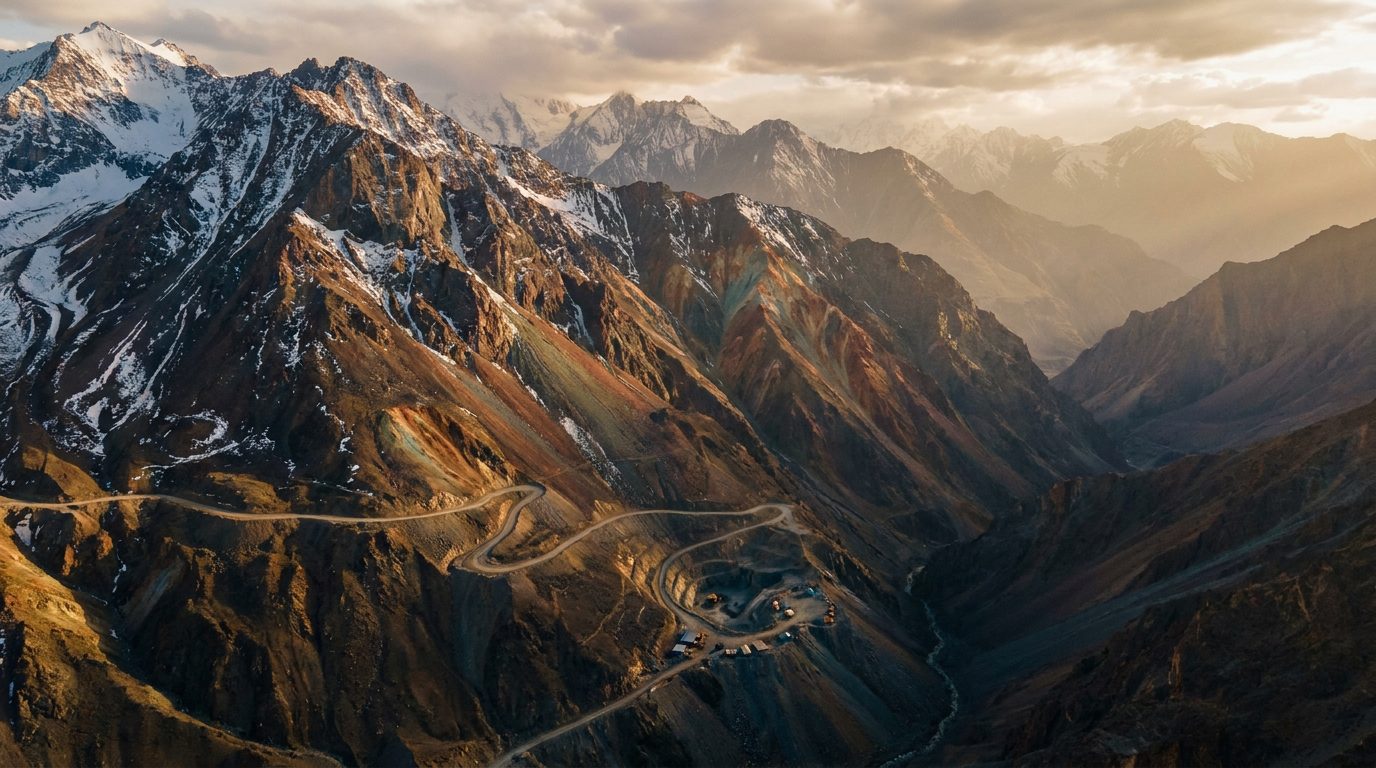
GBX Resources operates mineral concessions across twelve regions of Gilgit Baltistan — recovering copper, gold, antimony, molybdenum, tungsten and nephrite from one of the most mineral-rich, least developed terranes on earth.

01 / Company

A mining house, grounded in the Karakoram.

GBX Resources is a privately held mineral development company holding concessions across Gilgit Baltistan — the convergence of the Himalaya, Karakoram, and Hindu Kush ranges. The region sits within Pakistan's main metallogenic belt and contains, by independent geological assessment, some of the largest unexplored deposits of copper, gold, and critical minerals in South Asia.

We are operators first. Our portfolio is built mine by mine — through ground geological work, community engagement, and direct relationships with the Government of Gilgit Baltistan. We focus on minerals the world has come to need: those that electrify, those that defend, and those that endure.

From base metals like copper and lead to the rare strategic ones — antimony, tungsten, molybdenum — our holdings span the spectrum a modern economy is built on.
0+
Minerals in portfolio
Base, precious, critical & industrial
0
Regional sites
Across Gilgit Baltistan
0k km²
Region area
Among the world's most mineral-rich terranes
0%
Pakistan operations
Local jobs, local supply chains
02 / Portfolio

Eleven minerals. One mountain range.

From copper for the energy transition to nephrite jade for global luxury markets — our concessions span industrial, precious, and strategic materials. Several appear on the United States, European Union, and United Kingdom critical minerals lists.

CopperAntimonyMolybdenumGoldNephriteLeadPlacer GoldGraniteTungstenSilverBauxite CopperAntimonyMolybdenumGoldNephriteLeadPlacer GoldGraniteTungstenSilverBauxite
No. 01 / Base Metal
Copper
Cu · 29

The foundation of electrification. Demand projected to nearly double by 2035 as grids modernise and electric vehicles scale. Copper is the most important industrial metal of the energy transition.

Critical
No. 02 / Strategic Metal
Antimony
Sb · 51

A flame retardant, an alloy strengthener, and a defence-grade mineral. Listed as critical by the US, EU, and UK — supply concentrated in two countries globally. Pakistan is positioned to matter.

Critical
No. 03 / Refractory Metal
Molybdenum
Mo · 42

Mixed with steel, it produces alloys that survive pressure, heat, and corrosion. Pipelines, jet turbines, nuclear reactors — molybdenum is in all of them.

Strategic
No. 04 / Precious Metal
Gold
Au · 79

Timeless store of value, increasingly an industrial necessity. Both lode-vein and alluvial deposits across our holdings. The Karakoram's geology has produced gold for thousands of years.

Precious
No. 05 / Ornamental Stone
Nephrite
Ca₂Mg₅

A jade variety prized by East Asian luxury markets for over three millennia. Pakistan's nephrite deposits — particularly in Skardu and Bunji — are among the highest grade outside of Russia and Canada.

Premium
No. 06 / Base Metal
Lead
Pb · 82

Lead-acid batteries continue to dominate vehicle starter systems and grid storage globally. Demand remains structurally strong, with high recyclability and stable price floors.

Base
No. 07 / Alluvial Deposit
Placer Gold
Au — Alluvial

Stream-borne gold concentrated over millennia of glacial erosion. The Indus, Gilgit and Hunza river systems carry gold throughout their courses — recoverable with low overburden, low energy, low water impact.

Precious
No. 08 / Dimensional Stone
Granite
Igneous

Architectural-grade dimensional stone from the Karakoram batholith — one of the largest granite intrusions on the planet. Premium colours and unique veining for international markets.

Industrial
No. 09 / Refractory Metal
Tungsten
W · 74

The highest melting point of any element. Indispensable for armour-piercing rounds, drill bits, aerospace components. Listed as critical by every major industrial bloc.

Critical
No. 10 / Precious Metal
Silver
Ag · 47

Industrial and monetary metal. Photovoltaic demand alone is on track to consume more than one-fifth of annual mined supply by 2030 as solar capacity expands worldwide.

Precious
No. 11 / Ore Mineral
Bauxite
Al(OH)₃

The primary ore of aluminum. Lightweight transportation, aerospace, and packaging applications continue to drive global aluminum consumption upward year after year.

Industrial
Portfolio expanding
& more
In active study

Active geological assessment is ongoing across several additional sites — including lithium-bearing pegmatites and rare earth indicators identified through remote-sensing analysis.

03 / Geography

Twelve sites. One mountain kingdom.

Our concessions span the principal mineralised districts of Gilgit Baltistan — from the alluvial flats of Bunji to the high pegmatites near Chapursan, from the marble valleys of Skardu to the antimony-bearing zones of Chilas.

N SKARDU CHILAS GILGIT TURU GHIZAR SINGUL DAREL BARGO DHARMINDAR CHAPURSAN BUNJI BATHRAIT
01
Skardu — Baltistan
35.30°N · 75.63°E
02
Chilas — Diamer
35.42°N · 74.10°E
03
Gilgit — Capital
35.92°N · 74.31°E
04
Turu — Astore
35.45°N · 74.85°E
05
Ghizer
36.18°N · 73.50°E
06
Singul — Ghizer
36.07°N · 73.42°E
07
Darel — Diamer
35.78°N · 73.45°E
08
Bargo — Baltistan
35.42°N · 75.95°E
09
Dharmindar — Diamer
35.30°N · 73.95°E
10
Chapursan — Hunza
36.83°N · 74.95°E
11
Bunji — Astore
35.66°N · 74.62°E
12
Bathrait — Bagrote
35.97°N · 74.45°E
04 / Operations

From licence to logistics.

Our operating model integrates four disciplines — geology, extraction, processing, and logistics — under one roof. We hold the licences, we work the rock, we move the material.

Phase 01
Exploration & Survey
Remote-sensing analysis, on-ground geological mapping, sampling and assays — building the resource picture before a single excavator moves.
Phase 02
Concession & Permit
Lease acquisition, environmental clearances, community consultations, and full regulatory approval from the Government of Gilgit Baltistan.
Phase 03
Extraction
Open-pit and selective underground methods, calibrated to deposit geometry. Equipment is sized to the deposit — not the other way around.
Phase 04
Processing & Logistics
On-site beneficiation where viable, then transport down the Karakoram Highway to Karachi Port — or rail and road into the country's metallurgical hubs.
05 / Investors

Why Pakistan, why now.

The world is in the middle of the largest reshuffling of mineral supply chains since the Industrial Revolution. Friend-shoring, resource security, and the energy transition are forcing a fundamental rethink of where minerals come from. Pakistan — and Gilgit Baltistan in particular — has been overlooked. That is changing.

01
Untapped geology
Independent geological assessments have repeatedly placed Pakistan's mineral endowment among the largest in the world — with Gilgit Baltistan being the least explored portion of an already underexplored country.
02
Critical minerals exposure
Our portfolio includes antimony, tungsten, and copper — three minerals on the critical lists of the United States, the European Union, and the United Kingdom. Supply is structurally short. Buyers are looking.
03
Government alignment
Mining and critical minerals have been declared national priorities at the federal level. The Government of Gilgit Baltistan has the authority — and the appetite — to streamline licensing for serious operators.
04
Logistics on our doorstep
The Karakoram Highway connects us to two large economies overland. The Indus runs south to Karachi Port. We are not a remote operation — we are a connected one.
Pakistan's mineral sector has the potential to deliver many times its current contribution to the national economy — provided the right operators, the right capital, and the right governance arrive together.
— Industry consensus, repeatedly stated at the Pakistan Minerals Investment Forum
06 / Impact

We live here too.

Mining touches land, water, and people. We choose where it touches them, how, and for how long. Our impact framework rests on three commitments — to community, to environment, and to the country.

Local first hiring
Crews from the valley they work in. Skills transfer to the next generation. A mining operation that disappears in five years is not what we are building.
Water stewardship
Closed-loop water systems wherever feasible. Stream diversion is the last option, never the first. We monitor, we measure, we report.
Restoration plans, day one
Closure is designed before extraction begins. Land returned to a usable state — pasture, forest, watershed — funded by the operation that opened it.
07 / Newsroom

News & dispatches.

Updates from the field, the office, and the wider Pakistani mining sector.

First geological surveys completed across all twelve concession areas.

A combined ground-truth and remote-sensing campaign has been completed across the GBX portfolio. Preliminary indications confirm copper, gold, and antimony anomalies consistent with historical reports.

Read →

Pakistan's critical minerals strategy moves forward.

National-level policy work has accelerated through 2025 and 2026, with Gilgit Baltistan singled out for its concentration of critical and strategic minerals. We summarise what the framework means for operators on the ground.

Read →

Community engagement frameworks: what we learned in Skardu.

Our community engagement work in the Skardu and Bargo valleys produced a framework we now apply across the portfolio. The single biggest lesson: listening comes first, geology comes second.

Read →
08 / Contact

Talk to us.

For investment enquiries, offtake agreements, technical partnerships, or just to learn more — we read every message.

Email
Investor & partnership enquiries
Office — Pakistan
Karachi · Gilgit
Head office and field operations
Sector
Mineral Exploration & Mining
Privately held · Pakistan-incorporated
Coordinates
35.92°N · 74.31°E
Approximate centroid of operations